
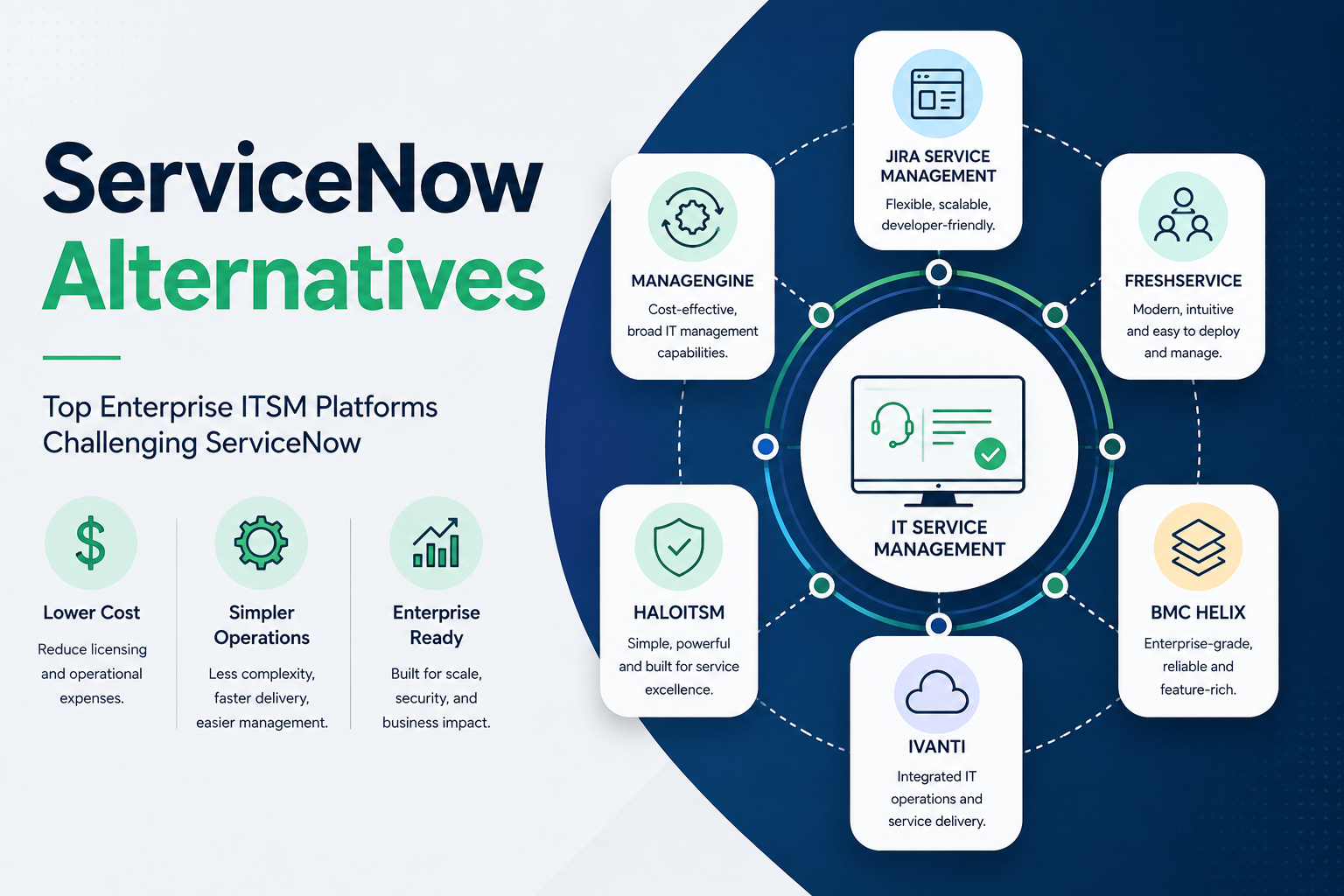
ServiceNow Alternatives: The Enterprise ITSM Platforms Challenging ServiceNow
The Enterprise ITSM Platforms Challenging ServiceNow
SEO Meta Description: Explore the leading ServiceNow alternatives in 2026, including Jira Service Management, Freshservice, ManageEngine, HaloITSM, BMC Helix, and Ivanti.
ServiceNow remains one of the strongest enterprise IT service management platforms on the market. But it isn’t the only option anymore.
Organizations are increasingly evaluating whether ServiceNow’s capabilities justify its licensing costs, implementation complexity, customization requirements, and ongoing administration.
That creates a growing market for ServiceNow alternatives.
For enterprise architects and IT leaders, the question isn’t simply which platform is “better.” The real question is:
Which ITSM platform provides the capabilities your organization actually needs at the right total cost and level of complexity?
The ServiceNow Alternatives Market Is Changing
ServiceNow continues to lead the enterprise ITSM market. Gartner and ISG continue to position ServiceNow as a market leader, while platforms such as Atlassian Jira Service Management, Freshworks, ManageEngine, BMC Helix, Ivanti, and HaloITSM are competing for enterprise customers.
Gartner’s recent ITSM research has evaluated several of these vendors alongside ServiceNow, including Atlassian, Freshworks, Halo, ManageEngine, BMC Helix, SysAid, and SymphonyAI.
ISG’s 2026 IT Management Buyers Guide also evaluates a broad field of ITSM providers, with ServiceNow maintaining a leading position while several alternatives receive strong ratings.
The takeaway is simple.
ServiceNow still sets the benchmark, but enterprise buyers have more credible choices than they did several years ago.
Why Organizations Are Evaluating ServiceNow Alternatives
Cost is one of the biggest reasons organizations investigate alternatives.
But cost isn’t the only issue.
A ServiceNow environment can accumulate substantial expenses beyond software licensing.
Those costs can include implementation partners, developers, administrators, upgrades, integrations, custom applications, configuration, training, governance, and ongoing platform management.
An organization may eventually reach a point where it asks:
Are we using enough of the platform to justify the complexity?
That question becomes particularly important when a company primarily uses ServiceNow for traditional ITSM capabilities such as incident management, problem management, change management, service requests, knowledge management, and a basic CMDB.
A simpler platform may provide enough functionality without requiring the same level of investment.
The Leading ServiceNow Alternatives
The following platforms deserve attention when evaluating a ServiceNow replacement or partial migration.
1. Jira Service Management
Jira Service Management is one of the most significant alternatives to ServiceNow.
Atlassian has a major advantage in organizations that already use Jira and Confluence.
Instead of maintaining separate ecosystems for software development and IT service management, organizations can connect development, operations, service management, knowledge management, and project workflows through the Atlassian ecosystem.
Jira Service Management can be particularly attractive to technology companies, software organizations, and enterprises with mature DevOps practices.
Best fit: Technology-centric organizations and enterprises already invested in Atlassian.
Potential advantage: Strong ecosystem integration and potentially lower platform complexity.
Potential challenge: Organizations with extremely sophisticated ServiceNow implementations may need significant architecture and process redesign.
2. Freshservice
Freshservice takes a different approach.
Instead of trying to reproduce every possible ServiceNow capability, Freshservice focuses on delivering a relatively straightforward IT service management experience.
That can make it attractive to organizations that believe their current ServiceNow environment has become too complex.
Freshservice provides capabilities around incident management, service requests, problem management, change management, asset management, automation, knowledge management, and reporting.
Best fit: Mid-market and enterprise organizations that want modern ITSM without excessive platform complexity.
Potential advantage: Simpler administration and strong cost/value positioning.
Potential challenge: Highly customized enterprise environments may require additional products or integrations.
3. ManageEngine ServiceDesk Plus
ManageEngine deserves serious consideration for organizations focused heavily on total cost of ownership.
ServiceDesk Plus combines IT service management with broader IT management capabilities.
Depending on the edition and surrounding ManageEngine products, organizations can address areas such as ITSM, IT asset management, configuration management, discovery, endpoint management, and automation.
That broader ecosystem can make ManageEngine particularly interesting for organizations looking for a cost-conscious alternative to a large ServiceNow deployment.
Best fit: Cost-conscious enterprises and organizations wanting broad IT management capabilities.
Potential advantage: Strong price-to-capability proposition.
Potential challenge: Organizations may need to carefully evaluate the overall architecture rather than assuming one product replaces every ServiceNow capability.
4. HaloITSM
HaloITSM is one of the more interesting platforms to watch in the ServiceNow replacement market.
Unlike many ITSM vendors that compete primarily for new customers, Halo has increasingly appeared in discussions around organizations moving away from larger and more complex ITSM platforms.
Its appeal comes from a combination of ITSM functionality, configurability, and a relatively straightforward platform model.
That makes it particularly interesting for organizations asking:
Can we simplify our ITSM environment?
Can we reduce licensing costs?
Can we reduce dependency on specialized platform resources?
Can we eliminate unnecessary customization?
Best fit: Organizations actively considering an ITSM migration or looking for a simpler enterprise platform.
Potential advantage: Strong ServiceNow replacement narrative.
Potential challenge: Large global enterprises should evaluate scalability, integrations, governance, and ecosystem depth carefully.
5. BMC Helix ITSM
BMC remains one of the most established enterprise alternatives to ServiceNow.
BMC Helix is not necessarily the “cheap ServiceNow” option.
Instead, it is an alternative for organizations that require sophisticated enterprise IT service management capabilities and want to evaluate a different strategic platform.
BMC becomes particularly relevant in large organizations with complex IT environments.
Best fit: Large enterprises with sophisticated ITSM requirements.
Potential advantage: Enterprise maturity and deep IT service management capabilities.
Potential challenge: Migration may not produce the dramatic cost reduction associated with moving to a simpler platform.
6. Ivanti Neurons for ITSM
Ivanti is another established enterprise IT management vendor.
Its ITSM capabilities sit within a broader IT management ecosystem, making it attractive to organizations that want to connect service management with other operational functions.
Ivanti is particularly worth evaluating where endpoint, asset, security, and IT operations capabilities are also strategic priorities.
Best fit: Organizations seeking broader IT management integration.
Potential advantage: Broad IT management portfolio.
Potential challenge: Buyers should evaluate the platform against their specific ServiceNow footprint rather than comparing ITSM features alone.
ServiceNow vs. Alternatives: The Real Decision
The wrong question is:
“Which ServiceNow alternative is the best?”
The better question is:
“Which platform provides the capabilities our organization needs at the lowest sustainable total cost and complexity?”
That requires an architecture-based evaluation.
A platform that costs 50% less but requires expensive customization isn’t necessarily cheaper.
Likewise, a platform that has fewer features isn’t automatically inferior.
If your organization never uses those features, they may simply represent unused complexity.
Evaluate Total Cost of Ownership
Enterprise architects should evaluate more than the annual software subscription.
A ServiceNow business case should consider:
| Cost Area | Questions to Ask |
|---|---|
| Licensing | What are we actually paying for? |
| Users | How many users and agents actually need licenses? |
| Modules | Which modules are actively used? |
| Implementation | How much did implementation cost? |
| Administration | How many resources maintain the platform? |
| Development | How much custom development exists? |
| Integrations | How many integrations require maintenance? |
| Upgrades | What resources are required for upgrades? |
| Consulting | How dependent are we on external ServiceNow specialists? |
| Training | How much ongoing training is required? |
| Customization | How much technical debt exists? |
| Governance | How much organizational overhead exists? |
This produces a much better comparison than simply comparing subscription prices.
The ServiceNow Exit Assessment
Organizations considering a migration should evaluate their current environment before selecting a replacement.
A useful assessment can examine five areas.
1. Business Capability
Document what the organization actually needs.
For example:
Incident Management
Problem Management
Change Management
Request Management
Knowledge Management
Service Catalog
IT Asset Management
Configuration Management
IT Operations
Application Management
Project Management
Security Operations
Customer Service
Governance, Risk and Compliance
Not every organization needs all of these capabilities.
2. Technical Complexity
Next, examine the existing ServiceNow architecture.
Look at:
Custom applications
Business rules
Flows
Integrations
APIs
Data structures
CMDB complexity
Custom tables
Reports
Dashboards
Portals
Automations
Technical debt
This is where many migration projects discover that their biggest problem isn’t ServiceNow itself.
It’s the architecture built around ServiceNow.
3. Platform Utilization
Determine how much of the platform the organization actually uses.
A company may own a large ServiceNow footprint while actively using only a small percentage of its capabilities.
That creates an opportunity for rationalization.
4. Alternative Capability Mapping
Map existing capabilities to potential replacement platforms.
For example:
| Capability | ServiceNow | JSM | Freshservice | ManageEngine | Halo |
| Incident | Strong | Strong | Strong | Strong | Strong |
| Problem | Strong | Strong | Strong | Strong | Strong |
| Change | Strong | Strong | Strong | Strong | Strong |
| Service Catalog | Strong | Strong | Strong | Strong | Strong |
| CMDB | Strong | Strong | Strong | Strong | Strong |
| ITAM | Strong | Strong | Strong | Strong | Strong |
| Automation | Strong | Strong | Strong | Strong | Strong |
| Enterprise ecosystem | Excellent | Excellent | Strong | Strong | Growing |
The table should only be the beginning.
The architecture team should also evaluate integration requirements, data migration, security, compliance, reporting, scalability, user experience, and operational support.
The Three ServiceNow Strategies
Organizations don’t always need to completely abandon ServiceNow.
There are actually three major strategies.
Strategy 1: Stay With ServiceNow
This makes sense when ServiceNow is deeply embedded across the enterprise and provides substantial business value.
The objective becomes optimization.
Reduce unused licenses.
Remove unnecessary customization.
Consolidate modules.
Improve governance.
Renegotiate contracts.
Reduce technical debt.
Strategy 2: Rationalize ServiceNow
This is often the most overlooked option.
An organization can retain ServiceNow for high-value capabilities while moving simpler workloads elsewhere.
For example:
ServiceNow for enterprise ITSM
Jira for development workflows
Specialized tools for endpoint management
Specialized security platforms for security operations
This creates a hybrid architecture.
The downside?
You introduce additional integration and governance requirements.
Strategy 3: Exit ServiceNow
A complete migration makes sense when the organization determines that the platform’s cost and complexity exceed its business value.
The migration should begin with capability mapping, data analysis, dependency analysis, and total-cost modeling.
The replacement platform comes later.
That order matters.
A Simple ServiceNow Exit Decision Framework
Enterprise architecture teams can use a simple scoring model.
Score each category from 1 to 5:
Business Value
How much strategic value does ServiceNow provide?
Platform Utilization
How much of the platform does the organization actually use?
Cost Pressure
How significant is the licensing and operating cost?
Technical Debt
How much customization and complexity exists?
Migration Complexity
How difficult would migration be?
Alternative Fit
How well do alternative platforms meet actual requirements?
Future Strategy
Does ServiceNow fit the organization’s future technology strategy?
A high cost score combined with low utilization and strong alternative fit creates a compelling case for further investigation.
Which ServiceNow Alternative Should You Evaluate First?
For most organizations, I’d start with four platforms.
Jira Service Management for organizations heavily invested in Atlassian.
Freshservice for organizations prioritizing simplicity and value.
ManageEngine ServiceDesk Plus for organizations prioritizing cost and broad IT management.
HaloITSM for organizations specifically considering a ServiceNow migration.
BMC Helix and Ivanti should remain on the shortlist for larger and more complex enterprises.
The right answer depends on the architecture, not the vendor ranking.
The Future of Enterprise ITSM
The enterprise ITSM market is moving toward more automation, AI-assisted service management, self-service, workflow orchestration, asset intelligence, and autonomous operations.
That creates another reason for organizations to reassess their platforms.
The question isn’t simply:
“Can this platform manage tickets?”
Almost every modern ITSM platform can.
The more important questions are:
How much does it cost?
How much administration does it require?
How much customization does it need?
How well does it integrate with our existing architecture?
How much automation can it deliver?
How much technical debt will it create over the next five years?
Those questions will increasingly drive enterprise ITSM decisions.
Platform Options Are Available
ServiceNow isn’t disappearing. It remains one of the strongest enterprise ITSM platforms available.
But that doesn’t mean every organization should continue expanding its ServiceNow footprint indefinitely.
For some companies, ServiceNow remains the right strategic platform.
For others, the better answer may be Jira Service Management, Freshservice, ManageEngine, HaloITSM, BMC Helix, or Ivanti.
The smart approach isn’t to start with the vendor.
Start with the business capabilities, architecture, utilization, cost, complexity, and future-state strategy.
Then select the platform that provides the best combination of capability, economics, flexibility, and long-term control.
That is the real ServiceNow alternative strategy.
Frequently Asked Questions
What is the best ServiceNow alternative in 2026?
There isn’t one universal winner. Jira Service Management, Freshservice, ManageEngine ServiceDesk Plus, HaloITSM, BMC Helix, and Ivanti are among the strongest alternatives to evaluate. The best choice depends on the organization’s requirements and existing technology ecosystem.
What is the cheapest ServiceNow alternative?
ManageEngine, Freshservice, and several other ITSM platforms can provide significantly different licensing economics than ServiceNow. However, organizations should compare total cost of ownership rather than subscription price alone.
Is Jira Service Management better than ServiceNow?
Jira Service Management can be a better fit for organizations already invested in the Atlassian ecosystem. ServiceNow remains stronger for organizations requiring a broad enterprise platform with extensive capabilities and deep customization.
Can a company migrate from ServiceNow to Freshservice?
Yes. ServiceNow-to-Freshservice migrations are technically possible, but the organization should first inventory data, workflows, integrations, customizations, CMDB dependencies, and business processes.
Can a company migrate from ServiceNow to Jira?
Yes. Jira Service Management is one of the most credible ServiceNow alternatives, particularly for organizations already using Jira and Confluence.
Is ServiceNow still the market leader?
Yes. Current Gartner and ISG research continues to position ServiceNow as a leading enterprise ITSM platform. The growth of credible alternatives doesn’t mean ServiceNow has lost its leadership position.
Should an organization leave ServiceNow?
Not necessarily. Organizations should first perform a ServiceNow value, utilization, architecture, and total-cost assessment. Sometimes optimization or rationalization produces a better result than a complete migration.
What should enterprise architects evaluate before replacing ServiceNow?
Enterprise architects should evaluate business capabilities, licensing, utilization, integrations, data, CMDB complexity, custom development, technical debt, security, compliance, migration complexity, operating costs, and future-state architecture.
FrameworkLogic is an independent technology and enterprise architecture resource. Vendor capabilities, pricing, analyst positioning, and product features can change over time. Organizations should validate current vendor information and licensing before making technology decisions.