The End of Prompt Engineering: Why Your New Job Is Designing Loops
Bottom line: Prompt engineering is becoming a commodity. The real competitive advantage is designing autonomous loops with strong verification, clear constraints, and measurable goals that let AI work reliably without constant human intervention.
The End of Prompt Engineering: Why Your New Job Is Loop Engineering
For the last two years, working with AI has felt like babysitting. You write a prompt, read the output, spot a mistake, type a correction. You’re the operator, feeding context and instructions into a system that only moves when you hit enter. That exhaustion isn’t in your head. You’re trying to sync your own clock speed to the machine’s, and the friction is getting unbearable.
Heading into 2026, the industry’s moving from manual prompting to loop engineering: the discipline of stepping out of the inner execution cycle and architecting the track the agent runs on. You stop prompting agents and start designing the systems that prompt them for you. The unit of work isn’t a turn anymore. It’s an autonomous cycle that runs while you sleep.
The leverage has moved
Peter Steinberger put it plainly: “You shouldn’t be prompting coding agents anymore. You should be designing loops that prompt your agents.” Boris Cherny, who heads Claude Code at Anthropic, has already rebuilt his whole workflow around this. In his words: “I don’t prompt Claude anymore. I have loops running that prompt Claude and figuring out what to do. My job is to write loops.”
That’s the whole shift in two sentences. Prompt engineering optimized how you phrase a single instruction. Context engineering managed what information sits in the window: docs, history, tool definitions. Loop engineering is a level up from both of those. It’s the control structure deciding what to prompt, when to prompt it, and whether the result actually satisfies a goal you can verify. The 2024 prompt engineer, the person who obsessed over phrasing, is basically obsolete now.
The verifier is where the real bottleneck lives
Here’s the part people skip past too fast. The model generating output is a commodity now. It’ll produce code at close to zero marginal cost, all day, without complaint. The scarce thing in 2026 is the verifier.
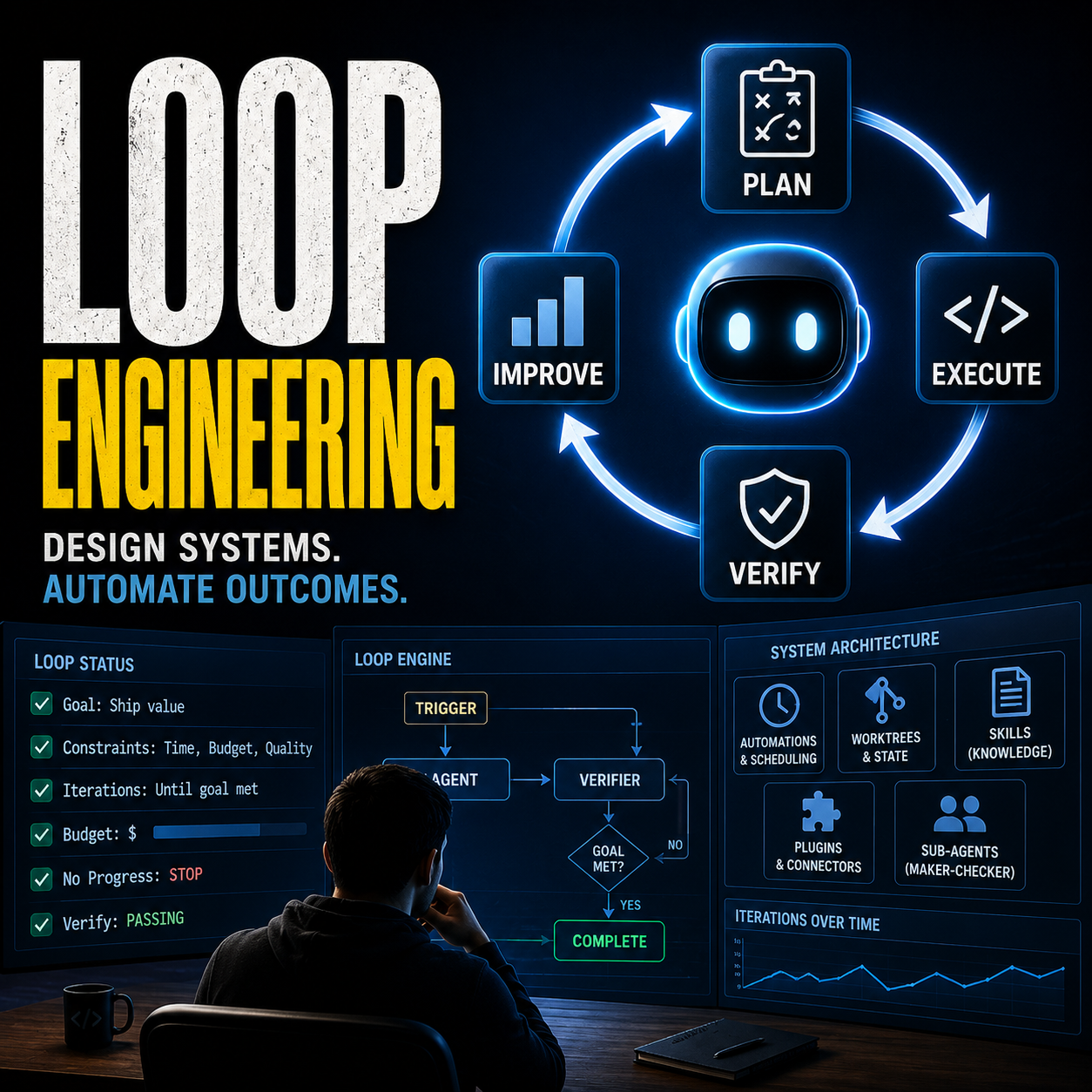
A loop, stripped down to its essence, is just a generator wired to a verifier. Weaken that verification half and you’ve built a slop machine: something that will confidently produce garbage a hundred times over because it has no real way to judge “done.” So you need hard stops built in. A ceiling on iterations, so nothing loops forever. No-progress detection, so the system halts when N passes produce zero measurable change. And a dollar budget, a genuine hard ceiling on spend. Skip that last one and you risk your own version of the Uber incident, where engineers reportedly burned a full year’s AI budget in four months before someone capped spend at $1,500 a month per person just to survive it.
Five pieces that make a system run itself
Getting past “a cron job wearing a hat” and into something resembling a real software factory takes five architectural pieces working together.
Automations and scheduling are the heartbeat, the triggers that wake the agent to triage and investigate on a set cadence, usually through something like a /loop command. Worktrees keep parallel execution safe by isolating agents in separate directories so they don’t step on each other; the git-backed state becomes the spine, giving you branching for parallel work and an audit trail when something needs to be undone. Skills capture persistent project knowledge, so instead of re-explaining your conventions every single turn, you write them once into a SKILL.md file the agent reads on every pass. Skip that and you’re paying down what amounts to intent debt, over and over. Plugins and connectors, usually built on protocols like MCP, let the loop reach past its own sandbox into issue trackers, databases, deployment pipelines, whatever’s real. And sub-agents handle the maker-checker split, because a model grading its own homework is, unsurprisingly, too generous with itself. You need a separate verifier, often a different model entirely, running adversarial instructions and judging the output against a /goal.
Steve Yegge’s “Gas Town” analogy captures the shape of this well. A mayor agent runs the outer loop, coordinating state, while patrol agents handle continuous inner loops of their own. The intelligence isn’t in one heroic marathon run. It’s in how well you coordinate these specialized roles over memory that actually persists, backed by git.
Ralph: dumb on purpose, and better for it
Before any of this got a name, there was the Ralph technique, from Geoffrey Huntley. Named after Ralph Wiggum, because it’s deliberately, almost aggressively simple: run an agent in a basic while-loop, wipe the slate clean every single pass.
The insight is the context reset itself. A long chat session degrades as the window fills up with dead ends and reasoning that’s gone stale. Ralph just sidesteps the whole problem by starting fresh for every unit of work. Claude Code and Codex have more or less turned this while-loop into their /goal command at this point, which tells you something: deterministic, boring iteration against a repo on disk beats a heroic one-shot attempt almost every time.
Winning fast has a cost nobody’s pricing in
Addy Osmani calls this comprehension debt, and it’s worth sitting with. When AI is wrong and a person accepts it anyway, they tend to feel more confident doing so, not less. One Wharton study found close to 75% of people did exactly that. An Anthropic study found engineers who worked through AI scored 17 points lower on a comprehension quiz than engineers who didn’t: 50% versus 67%. That’s not a rounding error.
Then there’s the orchestration tax. Your own cognitive bandwidth doesn’t scale the way agents do. Reviewing a hundred merged pull requests still takes human judgment, and that part doesn’t parallelize just because the code generation did.
Your only real moat is knowing what “correct” means
Andrew Ng’s three-loop model (agentic coding, developer feedback, external feedback) points at something important: you can automate the inner coding loop pretty thoroughly, but the outer loops still need what I’d call context advantage. People call it “taste” a lot, but I think that word undersells it. It’s the specific domain knowledge you have that the model doesn’t, and your job in loop engineering is translating that knowledge into a reward function the verifier can actually use.
Writing a good verifier is the new prompt engineering. It defines the end state, what evidence counts as proof, and which invariants can never break. Generation got commoditized. Your ability to define “correct” didn’t, and it’s not going to.
From operator to architect
Agents write code now. Fine. They don’t inherit what happens after, though. They can investigate, implement, even iterate, but they can’t decide, verify, or own the result the way you can. That’s still yours.
So the real work is owning the outer loop: teaching the task instead of doing it, systematizing it, and setting the constraints the machine has to work inside. Worth asking yourself honestly, next time you build one of these systems: are you building something that actually leverages your judgment, or just a faster way to hand it over?
Frequently Asked Questions
What is loop engineering?
Loop engineering is the practice of designing automated workflows that repeatedly plan, execute, verify, and improve work until a predefined goal is met. Instead of manually prompting an AI every step of the way, you build a system that manages the prompting automatically.
How is loop engineering different from prompt engineering?
Prompt engineering focuses on writing effective prompts for a single interaction. Loop engineering focuses on building systems that decide when to prompt, what to prompt, how to verify results, and when to stop.
What is context engineering?
Context engineering is the process of supplying an AI with the right information, documentation, memory, tools, and history so it can make better decisions. Loop engineering builds on context engineering by orchestrating the entire workflow.
Why are verifiers so important?
A verifier determines whether an AI’s output actually meets the objective. Without strong verification, AI systems can repeatedly generate incorrect or low-quality results while believing they are successful.
What makes a good AI loop?
Effective AI loops typically include:
- A clear objective
- An execution agent
- An independent verifier
- Success criteria
- Iteration limits
- Budget constraints
- Stop conditions when progress stalls
Can loop engineering replace software developers?
No. AI can automate much of the implementation work, but humans still define requirements, evaluate business value, make architectural decisions, and determine what “correct” actually means.
What tools support loop engineering?
Popular tools and concepts include AI coding agents, Git worktrees, MCP connectors, scheduled automations, persistent project memory, skills files, and maker-checker workflows using multiple agents.
What skills should developers learn instead of prompt engineering?
Developers should invest in system architecture, workflow automation, verification strategies, evaluation frameworks, AI orchestration, software testing, and domain expertise. These skills become more valuable as AI generation becomes cheaper.
Is prompt engineering becoming obsolete?
Not entirely. Writing good prompts still matters, but it is increasingly just one component of a larger autonomous system. The greatest leverage now comes from designing reliable loops rather than perfecting individual prompts.
What is the biggest takeaway from the shift to loop engineering?
The future belongs to people who design AI systems, not those who manually operate them. Success comes from creating workflows that continuously improve, verify their own work, and scale with minimal human intervention.