
Q-Day Explained: The Quantum Threat Framework Every Organization Must Understand Before Encryption Fails
The Quantum Threat Framework Every Organization Must Understand Before Encryption Fails
The idea of Q-Day is moving from theory into strategic planning reality.
Security leaders, governments, and technology companies are increasingly warning that quantum computing could one day break the encryption systems that protect modern digital infrastructure. While that day has not arrived yet, recent research suggests the timeline may be shorter than previously expected.
Understanding Q-Day is no longer optional for organizations that depend on digital systems, long-term data storage, or secure communications. It requires structured thinking, planning frameworks, and clear migration strategies.
This article introduces a practical Quantum Threat Preparedness Framework designed to help leaders understand what Q-Day means and how to prepare effectively.
What Is Q-Day?
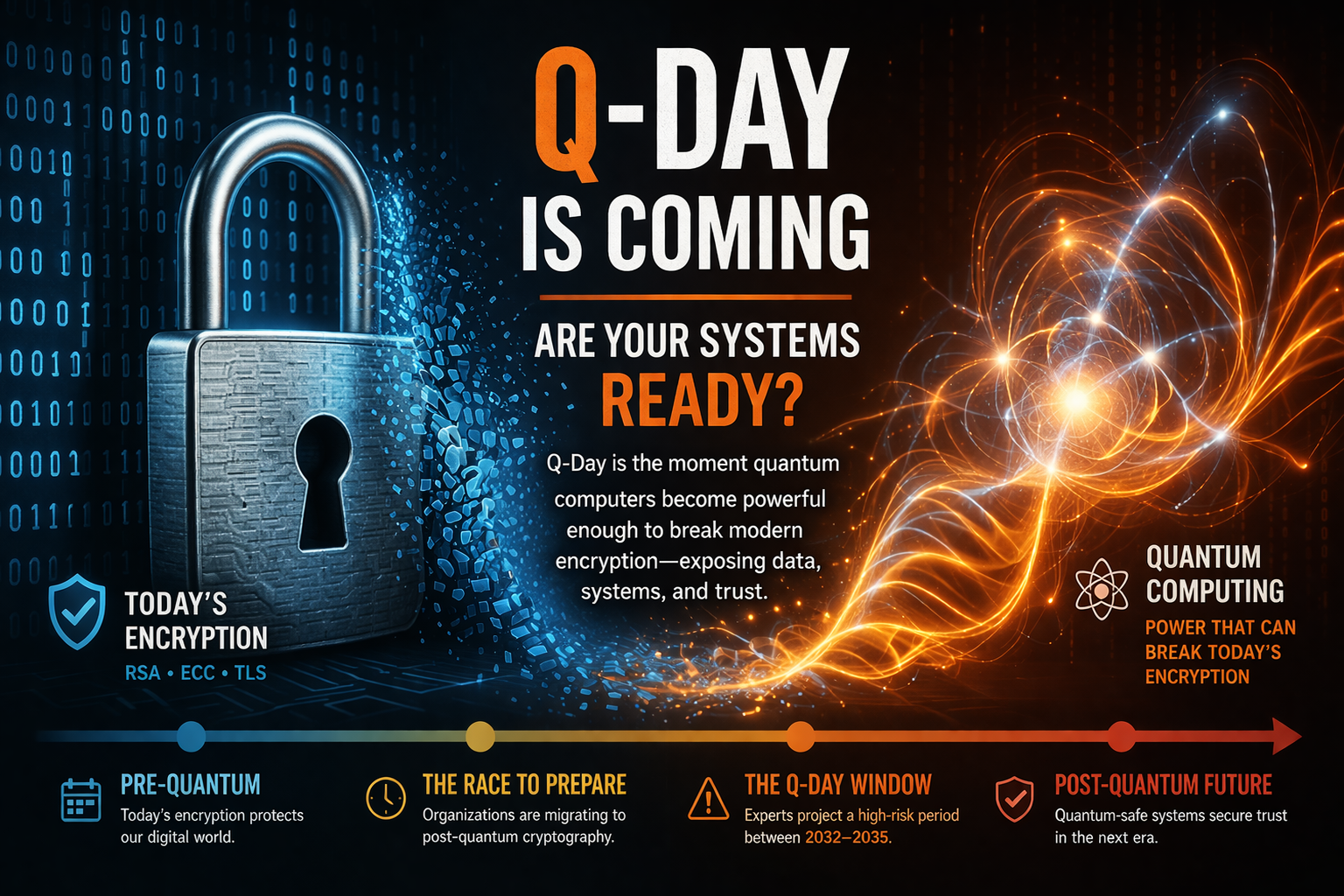
Q-Day refers to the moment when quantum computers become powerful enough to break widely used cryptographic algorithms.
These algorithms currently protect:
- Secure websites (HTTPS/TLS)
- Banking systems
- Digital signatures
- Cloud infrastructure
- Password authentication
- Cryptocurrency wallets
- Government and healthcare data
Most modern encryption relies on mathematical problems that are extremely difficult for classical computers to solve. Quantum computers, however, use fundamentally different computation methods that can solve certain problems dramatically faster.
When quantum computers reach the required scale, some of today’s encryption methods may no longer provide protection.
That moment is known as Q-Day.
Why Q-Day Matters Now
The urgency surrounding Q-Day is not based on speculation alone. It is driven by measurable advances in quantum hardware and cryptographic research.
Recent developments have shown:
- The number of quantum resources required to break encryption may be significantly lower than previously estimated
- Industry leaders are accelerating migration timelines
- Governments are publishing post-quantum migration standards
- Organizations are beginning long-term cryptographic modernization projects
The most important takeaway is this:
Even if Q-Day is years away, preparation must begin now because migration timelines are long.
Large organizations often require 10 or more years to fully upgrade cryptographic infrastructure.
Hidden Risk: Harvest Now, Decrypt Later
One of the most misunderstood risks associated with Q-Day is not future attacks, but current data exposure.
This risk is known as:
Harvest Now, Decrypt Later (HNDL)
This strategy involves:
- Intercepting encrypted data today
- Storing it securely
- Decrypting it once quantum capabilities become available
This creates long-term exposure risks for:
- Intellectual property
- Government archives
- Medical records
- Financial data
- Strategic communications
If data must remain secure for 10–30 years, it may already be vulnerable—even if encryption remains safe today.
Cryptography Most at Risk
Not all encryption systems are equally vulnerable.
The most widely used algorithms at risk include:
RSA Encryption
RSA relies on factoring large numbers, a task quantum computers could perform efficiently using quantum algorithms.
RSA protects:
- SSL/TLS certificates
- Secure email
- Authentication systems
- VPN connections
Elliptic Curve Cryptography (ECC)
ECC is commonly used due to its efficiency and smaller key sizes.
ECC protects:
- Cryptocurrency wallets
- Secure messaging
- Mobile authentication
- Blockchain systems
Digital Signatures
Digital signatures ensure that software and data originate from trusted sources.
If digital signatures fail:
- Software updates could be compromised
- Identity verification could be bypassed
- Trust systems could weaken
These risks extend beyond privacy—they affect system integrity and trust.
The Quantum Threat Preparedness Framework
To move beyond theory, organizations need structured preparation models.
The Quantum Threat Preparedness Framework (QTPF) provides a step-by-step approach to readiness.
Phase 1 – Cryptographic Discovery
Before planning upgrades, organizations must identify where cryptography exists.
Key discovery targets include:
- TLS certificates
- Encryption libraries
- Authentication mechanisms
- Key storage systems
- APIs and tokens
- Legacy applications
- Backup archives
This phase often reveals hidden dependencies that were undocumented or overlooked.
Without discovery, migration becomes unpredictable and costly.
Phase 2 — Risk Classification
Not all systems require immediate upgrades.
Systems should be classified based on:
Data Sensitivity
Examples:
- Public data
- Internal operational data
- Confidential regulated data
- National security data
Data Longevity
Questions to ask:
- How long must the data remain secure?
- Will exposure years later cause damage?
Long-lived data presents the highest risk.
System Criticality
Critical systems include:
- Identity infrastructure
- Payment systems
- Supply chain software
- Security platforms
Prioritization prevents wasted resources.
Phase 3 – Cryptographic Agility Design
Cryptographic agility is the ability to replace encryption algorithms without rebuilding systems.
This is one of the most important design capabilities in the quantum era.
Agility involves:
- Modular encryption architecture
- Algorithm abstraction layers
- Centralized key management
- Version-controlled cryptographic policies
Systems built without agility become expensive to modernize.
Phase 4 – Post-Quantum Algorithm Adoption
Post-Quantum Cryptography (PQC) refers to algorithms designed to resist quantum attacks.
Organizations should begin testing:
- Quantum-resistant encryption algorithms
- Hybrid encryption models
- Performance compatibility
- Integration reliability
Early testing reduces risk during full deployment.
Phase 5 – Migration Execution
Migration typically involves:
- Updating certificate authorities
- Rotating cryptographic keys
- Replacing legacy libraries
- Updating hardware security modules
- Validating compatibility
This phase is operationally complex and time-intensive.
Phase 6 – Continuous Monitoring
Quantum readiness is not a one-time project.
It requires:
- Monitoring emerging quantum capabilities
- Tracking cryptographic vulnerabilities
- Updating policies regularly
- Maintaining crypto inventory records
Security is an evolving discipline.
Industries Most Affected by Q-Day
Some industries face significantly higher exposure risks due to data longevity and regulatory requirements.
Government and Defense
Government systems often store sensitive data for decades.
Exposure risks include:
- National security intelligence
- Defense infrastructure
- Diplomatic communications
Preparation timelines are already underway globally.
Financial Services
Banks depend heavily on encryption to protect transactions and identity systems.
Risks include:
- Transaction fraud
- Authentication compromise
- Data integrity loss
Financial institutions are among the earliest adopters of post-quantum strategies.
Healthcare
Medical data remains sensitive for the lifetime of patients.
Exposure risks include:
- Patient privacy breaches
- Regulatory violations
- Insurance fraud
Healthcare organizations must prioritize long-term confidentiality.
Cloud and SaaS Platforms
Cloud infrastructure hosts massive volumes of encrypted data.
Risks include:
- Multi-tenant exposure
- Credential compromise
- System-wide vulnerability propagation
Cloud vendors are already deploying early PQC testing environments.
The Q-Day Timeline: What Experts Expect
While timelines vary, most forecasts follow a similar structure.
Present–2028
Early preparation phase
Pilot testing of post-quantum algorithms
2028–2032
Rapid migration acceleration
Industry-wide standards adoption
2032–2035
High-risk window
Legacy encryption becomes unsafe
These ranges may shift based on breakthroughs in quantum hardware.
Common Misconceptions About Q-Day
Understanding what Q-Day is not helps prevent unnecessary fear.
Misconception 1 — Q-Day Will Collapse the Internet Overnight
Reality:
Migration will occur gradually, not instantly.
Systems will transition over years, not hours.
Misconception 2 — Quantum Computers Exist Today That Can Break Encryption
Reality:
Current machines are not yet capable of breaking modern encryption at operational scale.
However, progress is accelerating.
Misconception 3 — Only Governments Should Care
Reality:
Any organization storing long-term sensitive data should prepare.
Private-sector readiness is essential.
The Strategic Opportunity Behind Q-Day
Q-Day is not only a risk.
It is also an opportunity to modernize infrastructure.
Organizations that prepare early gain:
- Stronger security posture
- Reduced long-term upgrade costs
- Competitive trust advantages
- Regulatory readiness
- Improved system resilience
Forward-thinking organizations treat Q-Day as an architecture modernization event, not a crisis.
Practical First Steps for Organizations
Preparation begins with structured actions.
Recommended starting points:
- Inventory cryptographic assets
- Identify long-lived sensitive data
- Evaluate vendor quantum readiness
- Introduce cryptographic agility
- Begin post-quantum pilot testing
Small early steps reduce large future risks.
The Future of Security in the Quantum Era
The arrival of quantum computing represents one of the most significant technological shifts in modern computing.
Encryption has been the foundation of digital trust for decades. Quantum computing challenges that foundation and requires a new generation of security models.
Organizations that adopt structured frameworks, phased migration strategies, and long-term planning will be best positioned to adapt.
Q-Day is not simply a cybersecurity issue.
It is an architectural transformation challenge.